





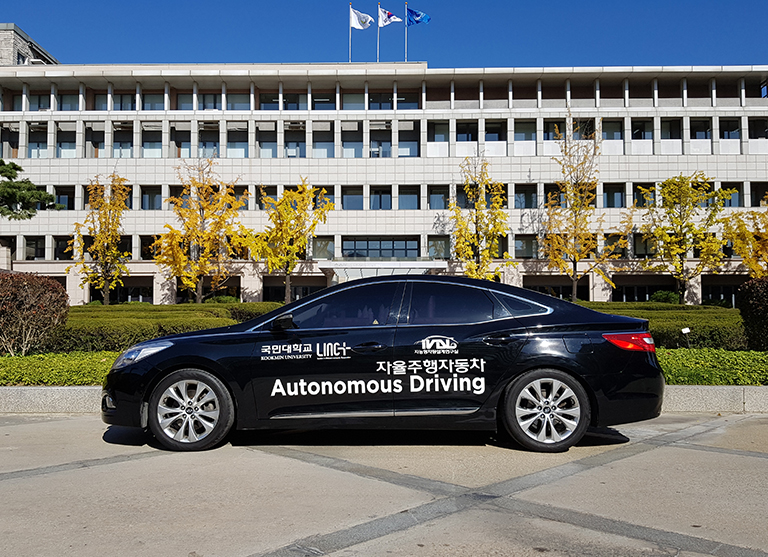
Established in 2014, the College of Automotive Engineering is Korea’s first college dedicated exclusively to automotive studies, founded with strong support from the Korean government and the automotive industry. Its mission is to nurture highly skilled professionals who will lead Korea—one of the world’s top automotive powerhouses—into the next era of mobility innovation. The college consists of three departments: the Department of Automotive Engineering (est. 1992), the Department of Automobile and IT Convergence (est. 2014), and the Department of Future Mobility (est. 2022), which together provide a comprehensive and future-focused education that integrates mechanical engineering, electronics, software, and smart mobility technologies.
Department of Automotive Engineering
The Department of Automotive Engineering, established in 1992, has led the advancement of Korea’s high-tech automotive industry by nurturing professionals who play central roles across academia and industry. The curriculum spans mechanical system design, vehicle dynamics, electronic control, and computer-based engineering, fostering engineers who can drive innovation in a rapidly evolving automotive environment. As an independent department under the College of Automotive Convergence since 2014, it is recognized as a distinguished institution for specialized automotive education.
-
Educational Objectives
The department aims to cultivate future-oriented automotive engineers equipped with advanced expertise, ethical responsibility, and the ability to translate technical knowledge into real solutions. Through a design-oriented curriculum combining theory and hands-on experimentation, students develop comprehensive and creative technical capabilities that contribute to the development of safe, eco-friendly, and human-centered mobility systems.
-
Educational System
The curriculum consists of basic engineering fundamentals, major courses in automotive design and control, and intensive design/experimental practice. Students gain foundational knowledge in mathematics, science, and computer studies before progressing to specialized fields such as vehicle powertrain, braking systems, chassis and body design, and vehicle dynamics. Practical training includes dismantling and assembling real vehicles and completing team-based Capstone Design projects, enabling students to build vehicles from prototype to final implementation.

Department of Automobile and IT Convergence
Established in 2014, the Department of Automobile and IT Convergence focuses on cultivating professionals with integrative expertise in automotive engineering, computer science, and electrical/electronic engineering. As automobiles evolve into intelligent, autonomous, and electrified systems, the department emphasizes the creation of new value through automotive–IT fusion, preparing students to lead next-generation mobility innovations.
-
Educational Objectives
The goal of the department is to nurture creative engineers who can develop convergent automotive technologies and independently analyze and solve real-world problems. Students are trained to acquire holistic understanding across automotive and IT fields to meet global trends such as electric vehicles, autonomous driving, and smart mobility platforms.
-
Educational System
The curriculum integrates basic engineering, advanced automotive systems, electronics, embedded systems, and computer programming. Students gain theoretical and practical experience through laboratory-based training, including electronic circuitry, embedded vehicle systems, and full-vehicle assembly exercises. Team-based design education—culminated through Capstone Design—strengthens creativity, collaboration, and problem-solving. Active participation of industry experts and field training further supports professional growth and employment competitiveness.

Department of Future Mobility
The Department of Future Mobility, newly established in 2022 under the direct support of the university president, aims to cultivate creative and interdisciplinary talents capable of leading next-generation mobility markets. The department addresses emerging transportation paradigms such as AAM/UAM, autonomous vehicles, robotics mobility, electric mobility platforms, drones, and AI-based smart transportation systems through a future-driven educational strategy.
-
Educational Objectives
The department strives to develop core talent who can explore, design, and lead new forms of mobility in the era of the Fourth Industrial Revolution. By fostering creativity, interdisciplinary expertise, and hands-on engineering competency, the program produces specialists capable of solving industrial and societal problems with a focus on Urban Air Mobility (UAM) and smart mobility systems.
-
Educational System
Students build broad engineering knowledge across mobility, mechanical and design, computer and AI, as well as electrical, electronics, and control engineering. The program offers forward-looking courses such as mobility planning and policy, experimental mobility practice, UAM operations, and intelligent transportation systems. A future-oriented Project-Based Learning structure—supported by experts from advanced mobility industries—promotes practical problem solving through interdisciplinary capstone design and undergraduate research programs (UROP I/II), ensuring close alignment with real industrial needs.